
- Illustrative example
- Digital product passport
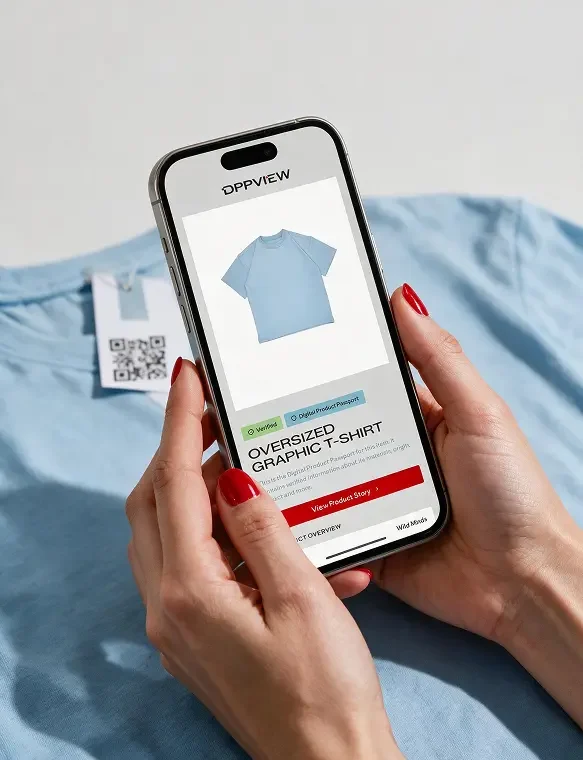
An illustrative Digital Product Passport example showing possible content and layout. It does not establish that product data has been verified or certified.
Go to homepage
A Digital Product Passport (DPP) is a digital record linked to a product through a data carrier, such as a QR code. It provides structured, machine-readable product information. The applicable legislation determines the required data, access rights and whether the passport covers a model, batch or individual item. ESPR provides the framework for product-specific requirements; battery and toy passports are governed by separate legislation.
The exact passport content is set by the legislation applicable to the product group. Under ESPR, this means product-specific delegated acts; battery passports have a separate legal basis. The categories below are examples of possible information, not a mandatory checklist for every passport:
Who is responsible
Responsibility depends on the applicable legislation and the economic operator’s role. Under ESPR, manufacturers must meet the relevant passport obligations, including when established outside the EU. Importers have their own duties to check product compliance and passport availability.
How It Works
An illustrative Digital Product Passport example showing possible content and layout. It does not establish that product data has been verified or certified.
Go to homepageIf a QR code links to a web page, the public information can usually be opened with a smartphone camera and browser. Other carriers may need compatible equipment. Access to restricted information may require authentication.
Access rights depend on the relevant product rules. For example, consumers may see care instructions, repairers spare-part information, recyclers material composition and authorities conformity documents. This is not a universal access model for every passport.
A marketing page linked to a QR code is not enough. Where a passport is mandatory, its content, access, security and availability period must meet the applicable requirements.
A product passport is not a file prepared once and then forgotten. Under ESPR, the product-specific delegated act sets its availability period, which must cover at least the product’s expected lifetime. Information must be updated as required by the applicable rules, with its integrity protected.
A product passport is not the same as an energy label or an EPREL record. EPREL is the EU product database for energy labelling. A DPP may contain broader information; check the requirements and any exemptions for the relevant product group.
Contact us
